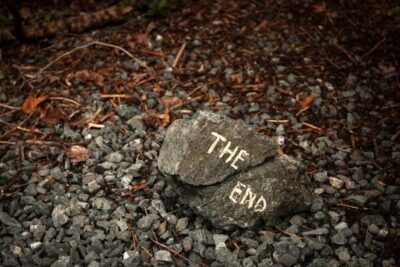
I’ve shared thoughts about the ending of a novel before, but I just read a book for review that brought the topic back to mind. It had a (groan) epilogue. So if you’ll indulge me, I’d like to reflect about a very important issue in novelizing. Where do you stop the story?
Conclusion. Full Stop.
This is an important and challenging matter. If you were a general, wouldn’t you want to know what the objective of your campaign was? Only then could you decide if it was Mission Accomplished or Oops. Same with us writers. Foresee what you want included in your plot—“This book is about the unlikely rise of Henry Tudor to the throne of England.” Then leave it at that.
Plotters will have the advantage here, because they can think about this before they begin typing. Part of your outline will be “Conclusion”, right? All the threads you’ve opened up will be, well, concluded. The adventure will be over. How many of the ramifications of the Great Quest do you need to include before the bard sits down? That’s up to you. But generally speaking, the sooner he sits the better. We all have a tendency to drag things on a little too long. I speak now as someone who critiques twelve or thirteen books a quarter. We go on too long.
The Final Verse
Ask any poet: The hardest thing is to know when to stop. Why spin out this explanation or that moral lesson when the reader has already figured it out? Let that punchy, beautiful line wrap it up without commentary. Pithy. Lapidary. Less is more. Etc. Novelists can learn a lot from their lyric brothers and sisters, who necessarily work in a parsimonious world.
Does the reader need to know what becomes of the characters twenty years later? Sure, she may want to know, but that’s the plot of your next novel. Are all questions posed in this book answered? Then it’s finished. Don’t drag it out even a little. That just dissipates the relief your readers feel at the climactic moment. Consider an example:
My Kingdom for an Ending
At the Battle of Bosworth Field, Henry Tudor kills King Richard and takes his crown. You’ve followed him scrabbling his way up to this moment. Where do want to end the story? 1) With Henry’s triumphal coronation, putting the VII after his name? It could be a big scene. Lots of glitz. Segues into his future reign, and all that. Or 2) just at that moment of staggering exhaustion when he picks up the crown from the ground on the battlefield and puts it on his head, and his men around him give a giddy cheer, realizing they’ve won? I know where I’d stop it.
And while I could go on, I won’t. I think you already know what I mean.

Jack Courtney
Amen!
David Edmonds
Hmm. Enjoyed this article and your many excellent points but am baffled by your objection to epilogues. I always appreciate books or movies that keep me in the story a few more pages. They allow me to wind down from the highs, savor a few more moments, and analyze what I liked and disliked. I’m also curious to know what your other readers think. Many thanks and best wishes.
Niki Kantzios
I’m clearly a subjective minority on the subject. I’d like to hear from readers too.