
Book covers are one of your most important marketing tools. People will judge your book by its cover. Is it fair? No. Is it reality? Yes. So let’s help you get the best cover you can possibly have, whether you are creating it yourself or hiring a designer.
Start with Research
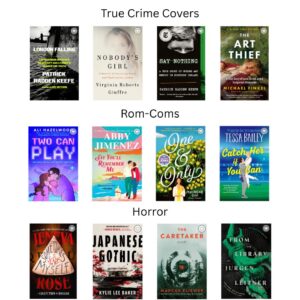
The great news is that we live in a time when looking at masses of book covers is quick and easy. No more venturing to the library and making a mess by pulling out tons of books. Nowadays you can just visit bookstore websites or Amazon and browse easily at home. Start by looking at covers that are in your genre. Take notes on what you notice. Any repeated art styles? What about font types? You want your cover to easily show what genre your book is; a good cover merges research and art.
Here are some examples of cover styles for different genres:
The Artwork
Your cover art should follow the basics of good art design. To start, the colors should match the tone of your book. Warm colors show energy and passion while cooler colors can denote calm or mystery. There should be contrast between elements but also balance to make it pleasing to the eye. Make sure there is a strong focal point and a hierarchy of movement where the viewer’s eye travels across the cover.
The Fonts
While your fonts should go with your genre, the most important element is that they are readable. Some script fonts that can be used for romance may be too elaborate for a book cover. Busy fonts for kids’ books can also detract from the main art of the cover.
When deciding a font pairing (two separate fonts that go together for the title and author for example), a serif and sans serif often go well together. You can look up popular font pairings or experiment and come up with your own.
Variations
It’s important that your cover design looks good for print and for ebook. You don’t want two different covers for the same book. You also want to make sure your cover is understandable at a very small size. Approximately 80% of books are sold through Amazon. Think about how people usually make these purchases—on their phones. So people are looking at tiny thumbnails to make their choice. You want your cover to show what your book is about in an inch or smaller.
Design Tools
Many times, covers are started using stock photos. Whatever you do, don’t go on Google images and grab anything you come across. You need to have the proper permissions to use photos for commercial purposes (book covers). You can either use images that are free (CCO) from sites like Pexels or Pixabay, or pay for premium photos on sites like Shutterstock. If you are looking for a more illustrated look, Creative Market has a great selection. (They have specialized fonts too!)
As far a design program itself, the Adobe suite of products is the gold standard (Illustrator, Photoshop). However, it is expensive and has a big learning curve. For a free, easy-to-use alternative, try Canva.
What About Using AI?
There isn’t an easy answer for this. AI is convenient, cost-effective, and can have good results, however there are moral issues to consider. The two major ones are first, that AI is often trained on stolen artwork, and second, that AI data centers are bad for the environment. Using AI also takes the opportunity away from a human artist. There are other articles that explore these issues in depth. What I will say is that you need to go by your own judgement and morals when deciding whether to use AI.
In Conclusion
Your book cover is more than art, it’s the outward representation of your hard work and dedication. It’s also your marketing plan’s best friend. Spend the time to have a cover that reflects the interior while attracting readers. If it’s in your budget, hire a good designer. You won’t regret the investment. And if you are doing it on your own, be sure to get feedback from other folks who have published books. You want to do everything you can to make your cover the best it can be. Make sure that when someone does judge your book by its cover, they come away with a good impression.

Joni M Fisher
Thank you, Arielle, for this information! I confess I have purchased books because of great artwork and style. I have also avoided buying a few books because the covers looked like they didn’t match the genre the blurb suggested.
Arielle Haughee
Thank you for reading, Joni! Glad you found it helpful.