Illustrators have beautiful, creative minds that can enhance your story exponentially. As with any working relationship, you want to have a good, productive one. The better you both work together, the better the book will turn out.
If you are looking for an illustrator, check out this blog post: Where Can I Find an Illustrator?
Once you’ve narrowed it down to one or more you’d like to reach out to, it’s important to follow the etiquette to get off on the right foot.
Start Here: Establish Your Budget
First, take a moment to think about the magnitude of your project and the amount of hours it will take to complete. Are you wanting an entire picture book of art? Several individual illustrations for a middle grade book? Maybe a map of your fantasy world? All of this takes time, and in some cases, LOTS of time for the illustrator. Keep that in mind while understanding how much getting custom artwork costs.
Your first step is to figure out your budget for the project. If you are wanting an entire picture book full of colorful illustrations, you are going to want to think in thousands, not hundreds. There are ways to reduce your costs (more later), but remember you are asking someone to put months of labor into a project and the price will reflect that.
So before you reach out to anyone, figure out what number range is comfortable for you. Keep in mind that you may not recoup the money. That is a risk every indie author takes when making a book.
There are a wide variety of illustrators available at different levels of pricing so it may take a little bit of work to find someone who is within your budget. The artists will base their price on several things: the amount of artwork, the size, the level of detail, the timeline, and their amount of experience.
Preparing Your Manuscript for an Illustrator
Start out by making sure the text has been professionally edited and is fully finalized. You don’t want to be making editorial changes when your manuscript is with the illustrator. Then you’ll need to figure out exactly how many illustrations you want and what size. For picture books, the best way to do this is to dummy the book.
(Check out these templates by Debbie Ohi to help you dummy.)
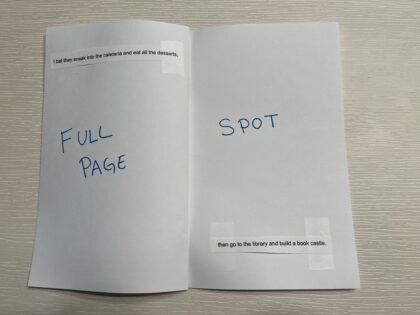
To dummy a picture book, get a stack of printer paper, a stapler, a printed copy of your manuscript, and some tape/glue. A standard picture book is 32 pages, so you’ll need eight pieces of paper. (Get as many as you need for your length book.) Fold all of the pages in half together and staple the middle, creating a booklet. Mark your title page, copyright page, and dedication as needed. Next, literally cut and paste your story text onto each page.
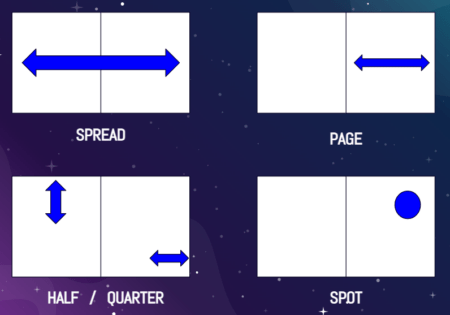
Look through your dummy and consider what size artwork would be best on each page of the story. Your options are full spread (most impact), full page, half page, quarter page, and spot (most cost effective). See the graphic below to learn the difference between each. Keep in mind the larger the art, the more it will cost. If you are trying to keep your costs down, consider the use of spot illustrations and white space. White space can be your friend!
Another thing to take into consideration is the cover. Covers usually cost more because artists put extra time and consideration into them. If you want an illustrated cover, do you want just the front cover or a full wrap-around spread where the artwork stretches from front to back?
Now that you know how much artwork and the size of each, it’s time to put together your project details.
Creating a Project Overview for the Artist
Putting everything together in an organized fashion makes it easy for the illustrator to decide if they would like to take on the project. You can create a separate document or send it in the body of an email. You’ll also need to decide your timeline. Giving the artist plenty of time will allow for better quality art. (I personally give a good chunk of a year for a fully illustrated picture book.)
Your project overview should include the following details:
- Media type: [watercolor, digital…]
- Trim size: [the size of your front cover]
- Number of illustrations: [total number of pieces of artwork]
- Illustration size: [for example, one wrap-around cover, seven two-page spreads, seven full pages, one half page, and seven spots]
- Timeline: [when you’d like final art]
You’ll notice there is nothing about picture notes (directions saying what to draw on each page) in the dummy or the project overview. That’s because illustrators don’t like them. They want to use their creative freedom to interpret the story visually. You need to trust your illustrator. They will likely come up with something even better than you the writer imagined! Check out this article with more info on why you shouldn’t use picture notes.
Approaching Illustrators: The Etiquette Portion
Whether you are reaching out via email, DMing on Instagram, or even talking in person, the first thing you want to do is ask if they are taking on new projects. Artists often take on multiple books, and they may not have the bandwidth for anything new. Don’t jump right into price! That’s a common mistake. You are starting a working relationship and want to be professional.
Next, share a little bit about your book. Make it sound exciting and fun, something they will want to join in on. Then offer to send over the project overview you’ve created. They may also want to see the full manuscript at this point. I usually create a digital version of the dummy so they can see what size art goes with what text on each page.
Something to avoid: never ask the illustrator to do free sample art. You are asking them to work for free, and it’s considered rude.
Give the artist time to decide if they want to do the project. Sometimes they just don’t connect with a story, and they aren’t a good fit. That’s why it’s always good to have several illustrators lined up to contact. You might need Plan B!
They Said Yes, Now What
This is the part where I tell you to get a lawyer, specifically one who does intellectual property (IP). You NEED a contract. Figure out project benchmarks and how and when to pay. All the details of work, payment, revisions, and rights should be in your contract. This will protect you should things go sideways.
Once work gets started, be sure to communicate regularly. The process usually involves initial art, revisions, then final artwork. When it comes time to give feedback on revisions, remember what it feels like to get your writing critiqued and how you prefer to have suggestions given to you. Give the same consideration to the illustrator with their artwork.
Seeing your story come to life with illustrations is truly thrilling. You can start a wonderful working relationship with a fellow professional, and you may end up doing multiple books together. Be sure to send them a few copies of the final product so they can show it off. You both will love sharing the beautiful book you’ve created together.
